
Context
Fusce sed enim gravida, pharetra lectus lobortis, consequat metus. Pellentesque vulputate odio nec erat congue, a tincidunt orci ornare. Nunc vehicula quis est vitae hendrerit. Phasellus quis fermentum est, ut aliquam tortor. Integer at est diam. Nunc maximus cursus euismod. Nulla et tellus non nibh aliquet lacinia. Nulla a mauris ac metus aliquet vestibulum sed eu metus. In sollicitudin ut leo vitae tincidunt. Donec faucibus metus efficitur, facilisis dolor a, scelerisque urna. Vivamus sapien odio, pellentesque sit amet sagittis vel, rutrum vel nisi. Duis ac ultrices urna, non auctor neque. Nunc sed risus tempus, dictum nulla a, accumsan orci. Vivamus condimentum turpis efficitur efficitur tempor. Ut in dictum leo. Vivamus sit amet mollis dolor.
An international beverage corporation required an immersive, interactive trade show activation to transport exhibition visitors straight to their primary manufacturing facility overseas. The virtual tour, guided by an expert narrator, needed to trace the complete production pipeline from raw ingredient processing to final packaging and logistics. The project carried exceptionally high stakes: a previous external vendor had built a legacy experience that completely failed to meet corporate quality and performance standards. The technical and logistical challenge required building a multiplatform ($2\text{ devices: VR and Mobile AR}$), trilingual ($3\text{ languages}$) application optimized for rapid throughput to handle large trade show crowds efficiently without causing operational bottlenecks at the booth.
Requirement
I was brought in to assume technical and strategic ownership of the rescue effort. I was tasked with defining intuitive interaction patterns, rectifying highly inconsistent data logs, mapping out the facility’s physical layout, translating and localizing narrative assets, and coordinating separate mobile AR and VR software development tracks under a heavily compressed event deadline.
Solution
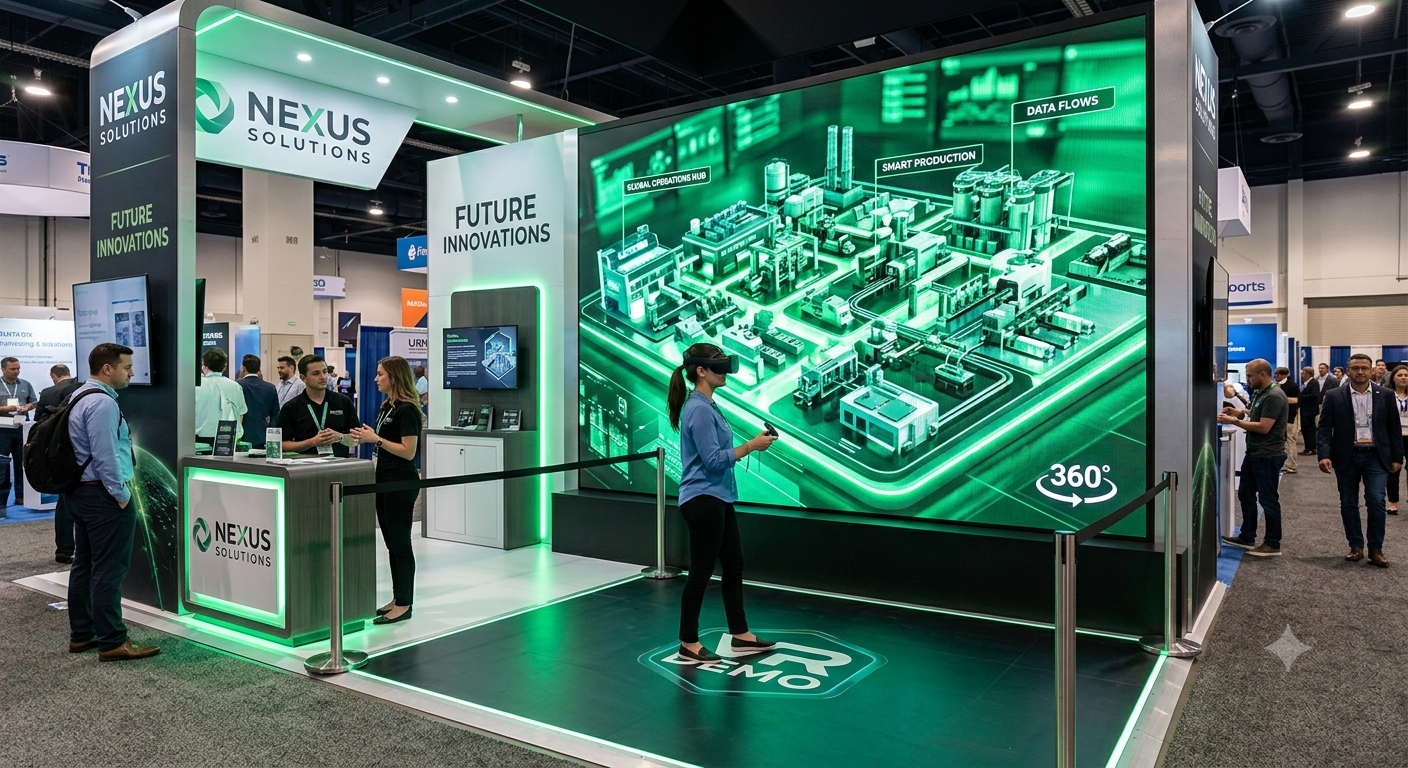
To maximize visitor throughput and eliminate the learning curve for non-technical users, I audited the initial concept and aggressively removed complex interaction mechanics, such as using VR hand-tracking to grab and inspect products. These patterns were too time-consuming for a trade show floor and required split development pipelines, so I implemented a streamlined “Touch & Poke” interaction model instead. The narrative experience was locked to a linear sequence where only one building marker was active at a time; clicking it transitioned the user into a high-fidelity $360^\circ$ production video segment. Once a segment concluded, the system automatically returned the user to the master map with no further input required. To balance user agency with strict time limits, I designed custom ambient UI icons to give subtle spatial cues, directing users where to look without breaking immersion. I mapped the industrial facility layout as a centralized, tabletop model inside a stylized ambient environment matching the corporation’s iconic emerald green brand colors, a choice that seamlessly accommodated both standing VR users and seated mobile AR users. When the raw asset data delivered by the client proved to be highly inconsistent—featuring fragmented, contradictory spatial video clips and unstructured narration logs—I conducted extensive layout research to map out the physical facility. This accurate blueprint was provided directly to the lead 3D artist, defining the exact modeling scope and preventing costly structural rework. Finally, because the client required a trilingual localized audio output but only possessed English audio assets, I introduced a voice AI platform to build an automated translation and voice-matching pipeline, leveraging regional voice models to ensure perfect dialectal accuracy and regional compliance.
Outcome
The prototype eliminated system friction, saved considerable development costs by catching asset mismatches early, and drew immense praise from division leadership. Despite a split development team handling separate AR and VR codebases, rigorous cross-functional alignment minimized technical friction and kept the project within its strict timeline. The successful trade show release directly secured a major multi-national enterprise account, expanding the company’s enterprise portfolio and immediately securing my transition into a long-term specialized role within the business unit.